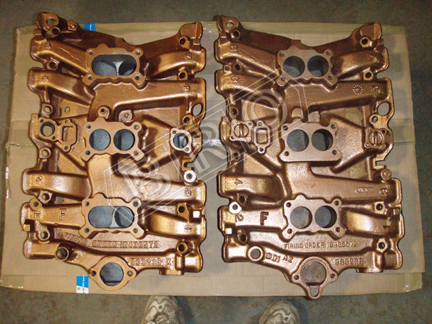
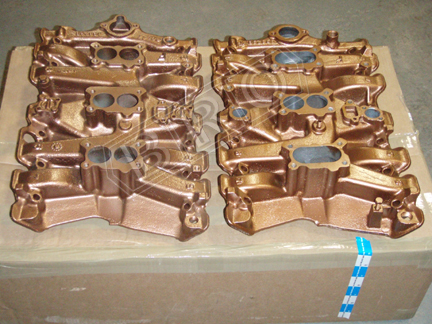
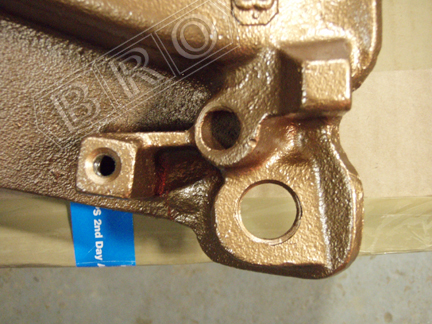
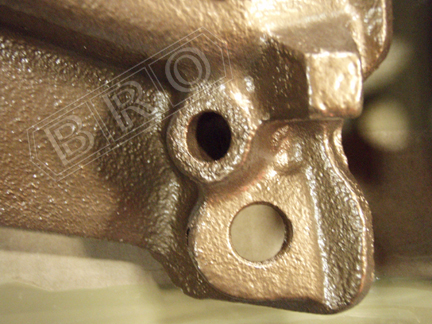
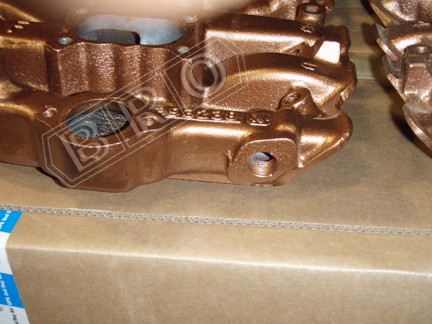
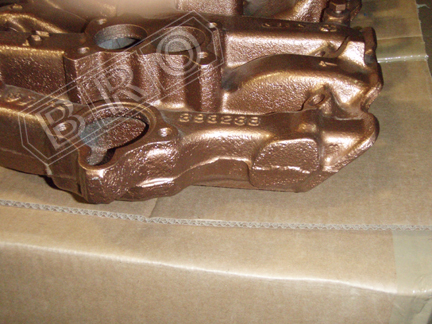
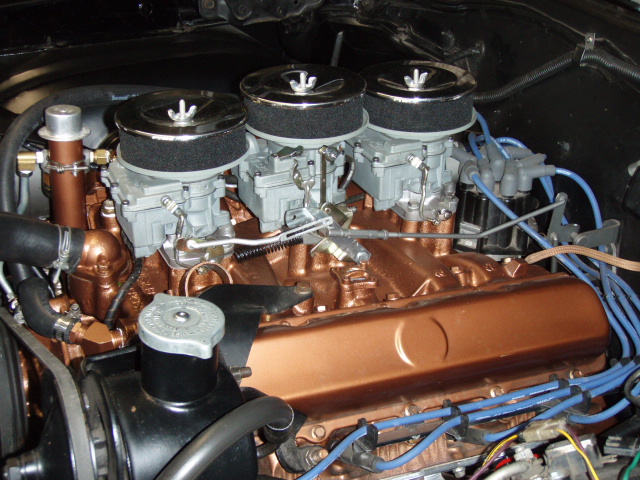
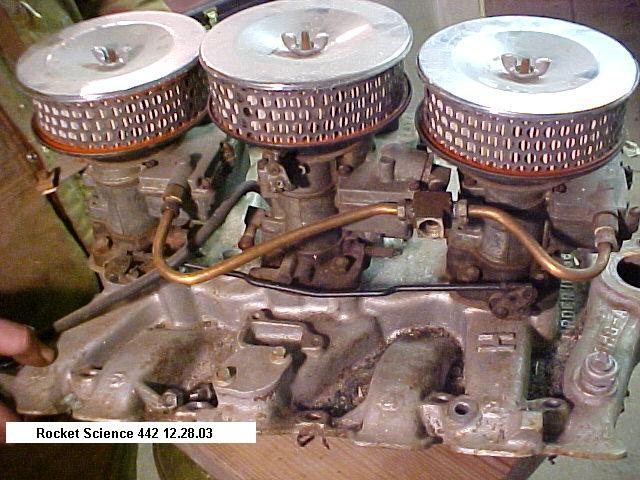
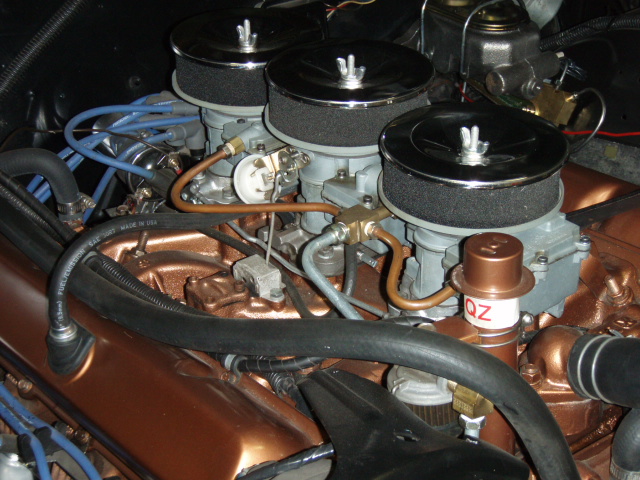
In late 64 and into early 65 the ground work was being laid for the first 442 with 3 two barrel carburetors. Contrary to popular belief, it was the 1965 442 that premiered the "Tri-Carb" not the 66. The first manifolds created by the Lansing engineers were experimental / developmental. They resemble the 1966 L-69 manifold, with the exceptions detailed below.
These manifolds were designated as "Out The Back Door", which was Oldsmobile's version of Chevy's COPO equipment. Much less is known about the Olds experimental equipment due to the decision to destroy some of the records & ship the rest into oblivion. There is no disputing the significant differences between the 65 and the 66 manifolds and since we know that the 66 L-69 was a half year option, there's no other explanation for this rare developmental manifold.
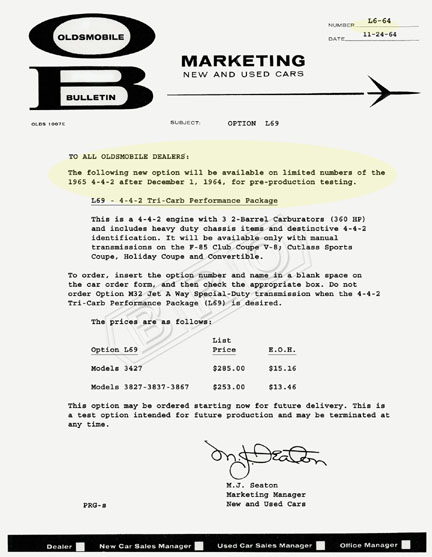
They were first supplied to a few Lansing drag racers for testing on the local tracks and later Oldsmobile issued a bulletin making them available for a limited time on the 1965 442's. You could order the "Tri-Carb" (they were not called tri-power) option by entering the L-69 code on the order form and for only $253.00 you could add what would become the rarest option ever offered on the 1965 442. This option was ONLY permitted on the 4 speed equipped 442's. The Olds hierarchy must have reversed this decision very quickly, because I, like everyone else, have never seen another one.
If you have any information to dispute or contribute to these manifolds, please email me. contact link above
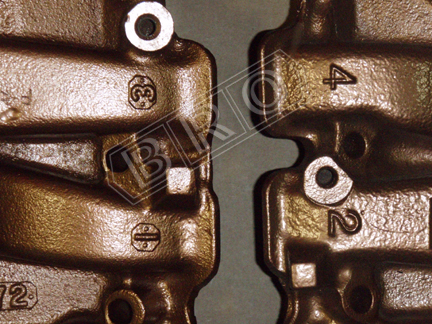
All of the the pictures on this page show the 65 intake on the left and the 66 on the right with the exception the rear view. I have water marked all of the photos with my logo so I can better authenticate & document others, if they still exist.
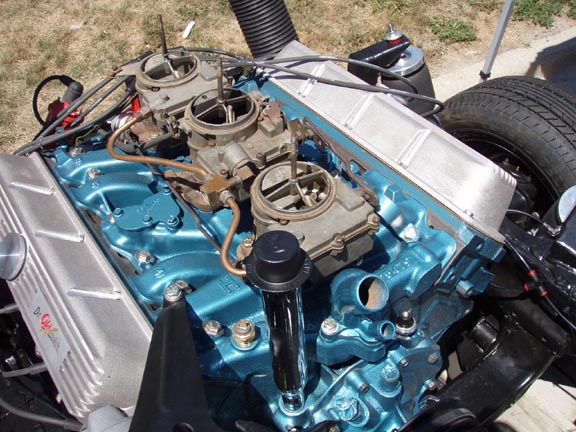
Experimental / Developmental 67 Tri Carb-documented by Chris Witt & Willis Dennis
If you were planning on having a tri-carb intake in 1967, what letter would it be?
Well... "H" is the next available letter.
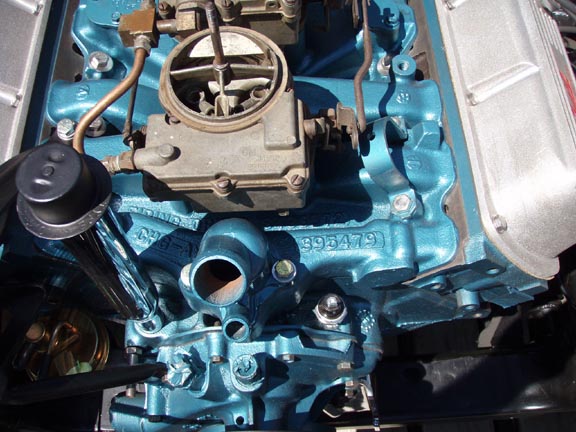
After the '67 Tri-Carb option was killed, that letter was assigned to the NEXT intake designed, the '68+ 2-bbl. Here's my evidence, a genuine 1967 Olds Tri-Carb Intake, casting ID H-395479.-Chris Witt
Center Carb Casting Difference
Documentation
2.) The thermostat housing is round and lacks the common by pass that connects to the water pump. The reinforced pad on the left front of the manifold was tapped with a 1/2 inch NPT pipe thread and a 45 degree pipe fitting with a hose connector was installed. This allows the by-pass on the water pump to be connected to the water jacket of the manifold..
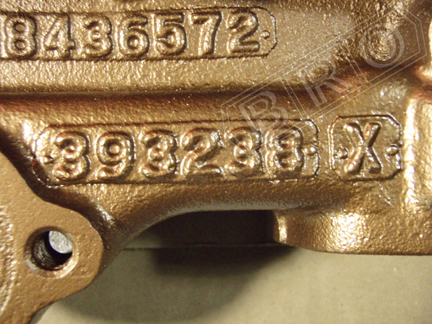
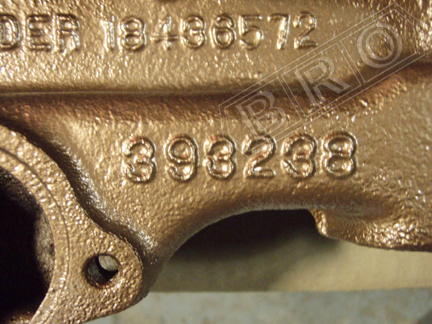
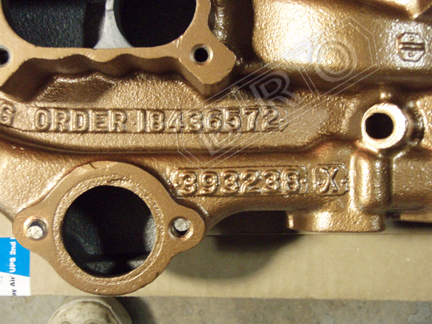
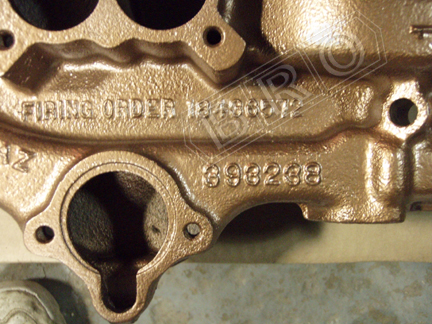
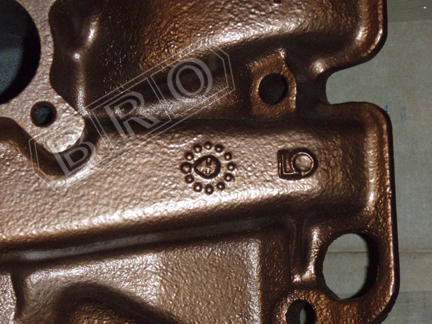
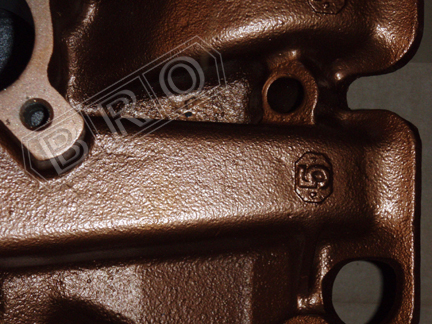
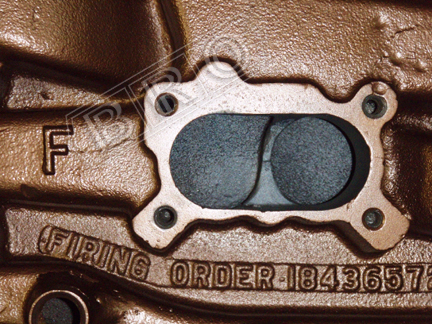
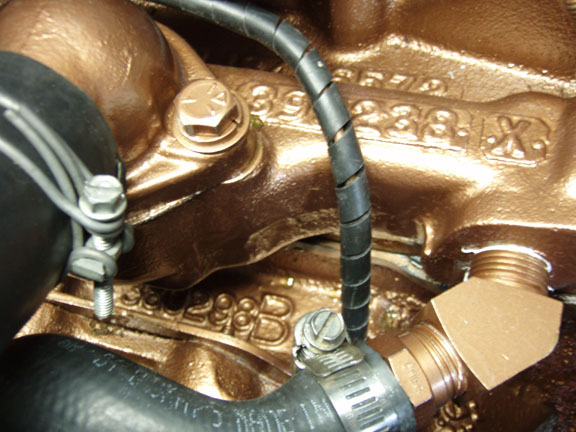
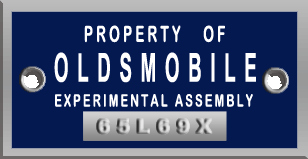
1.) All of the numbers were stamped onto metal strips and nailed into the casting mold. This is evident by the raised square under all of the numbers and the visible nail heads. It has most of the numbers that are found on the 66 L-69, but as you can see from the picture, they were cast in a completely different way. The most definitive difference is the "X" after the casting number. This designates this as an experimental manifold.
Casting Number Differences
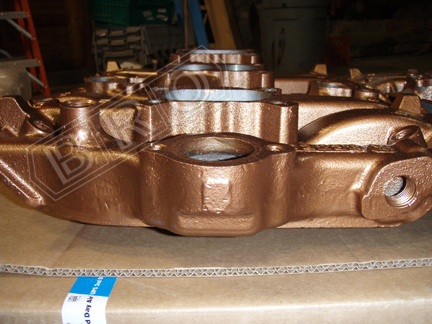
6.) There is a distinct difference in the shape of the castings for the center carb. Notice how the 66 has a straight front edge.
4.) The 65 has the tapped post on the right rear to mount the coil bracket which is lacking on the 66 all together.
3.) There was no allowance for the water temperature sending unit, so a 1/2 inch pipe coupling was welded to the front right side of the manifold. This was not the cleanest look, but remember, these were purely experimental.
Temperature Sending Unit
Number Style Comparisson
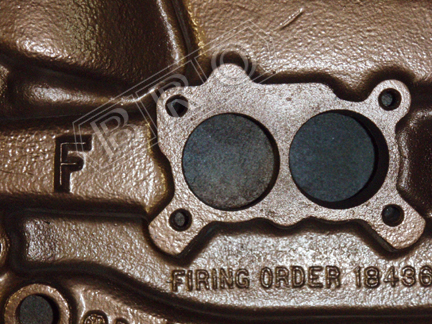
5.) Notice the front and rear inlets are oval shaped and not two separate holes like the 66 L-69 manifolds.
Intake Opening Differences
The Clock Is Missing All Together
The By- Pass Connected
Information
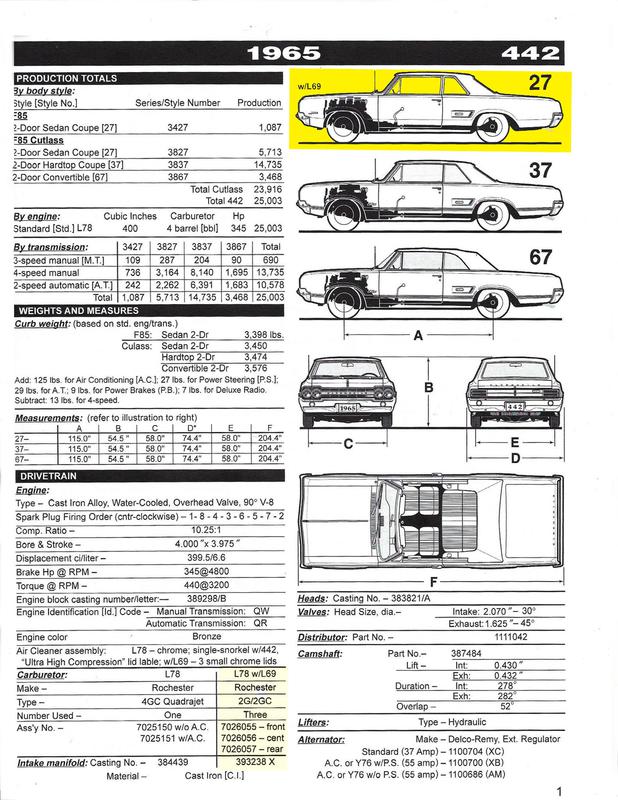
Oldsmobile, the team that brought us tri-power nine years earlier brought it back for 1966 only (or so most Olds people thought until now) on the 4-4-2; they referred to it as tri-carb (L-69). It featured a three 2GC Rochester two-barrel carbs on top of a blueprinted 400 engine. The L69 engine option featured three separate chrome air cleaners. The rare W-30 Ram Air option (only 54 were factory-built) which required L-69, also included a factory balanced and blueprinted engine with hotter cam, air scoops in the lower bumper, ducts leading to the air cleaner, trunk-mounted battery, four-speed transmission, 4.11 or 4.33 rear and was not available in the convertible due to the trunk mounted battery location. The carburetors were numbered 7026055, 7026056 and 7026057 and develop 360hp at 5,000 rpm with their 10.5:1 compression ratio. The true horsepower was actually believed to be closer to 400. The W-30 also was available as a dealer-installed package (Trac-Pac), of which 93 were sold. Note: The Ram Air duct holes thru the radiator support, on both the factory and dealer installed W-30's, were torch cut and not a punched hole.
Oldsmobile only produced 2,129 tri-carb 4-4-2s in 1966 and possibly only 2 in 1965 and only 1 of these has been documented to date.
BRO
I'm sure your tripower intake is an engineering piece dated in 1965 as that was when they would be finishing up the development for production in 1966 (Sep, 1965 start)...there were lots of them.
The Dale Smith "back door" program really got going in 1969 or 1970 when Engineering shifted from performance development to emissions development. That all went outside to Batten and others and Dale used to have a budget for the promo stuff he did. He has an excellent book on that named "Racing to the Future".
.. Dave Heilala Oldsmobile Engineer
BRO
I know this is not official documentation of the 1965 Tri-Power set up, but when I was stationed in Norfolk, Virginia in 1965, I went to the drag strip at Virginia Beach. I had a 1963 Ford Galaxy with a 406/Tri-Power set up. I was there with my friend who had a 1965 2 door sedan 442. We both had 4 speeds. He is the reason I have had a life long love affair with the 1965 442's. His car had a 4 barrel. There was another guy there that had a 1965 4 speed 442. And he had a factory Tri-Power set up. Because I had 3 2's, we talked about the differences between my Ford and his Olds. He said that the Tri-Power would become a factory option in 1966. I don't remember where this guy was from, whether he was also in the service or not, or really, anything about him. But this was definitely 1965, because I was transferred to Hawaii before the 1966 models came out. And the reason I can say that is because I had a 1965 Plymouth on order from the Plymouth dealer. I ordered the Hemi with a 4 speed. Because I was not an E-5 or above, I would have to pay for my car to be shipped to Hawaii and I had to cancel my order. I was transferred to Hawaii in August of 1965. So there is not a chance that this could have been a Tri-Power from a 1966 model retroactively fitted to a 1965. And he told me that it was a factory option.
As I said, this can not be considered documentation, but it may lend a little more to the fact that Olds did offer a Tri-Power option in 1965. And it was a true Oldsmobile manifold. Or one of the best forgeries I have seen. I did not race him, so no bench racing stories there.
Regards,
Claude Conn
Kissimmee, Fl.
1965 442 Sport Coupe
BRO
I don't know if anyone else has mentioned it but, in the late 60's Weise Oldsmobile in Kokomo, Indiana used to campaign a 65 olds 442 with a tri power setup. it was called "Reaction". Ray Ebert
This is a copy (not the original) which was found found among many copied documents. It has been disputed by very knowledgeable Olds historians (for lack of a better word) which raised many questions about it's authenticity. There were discrepancies in the document numbers and other points which lead them to believe it to be forged. None of us understand why or what would be gained by doing so, but in a search for true documentation, I need to make this known. BR[]
Experimental 65 Tri-Carb with Manifold X designation Shown In GM OEM Manual.
The 1965
Front-7026055 Center-7026056 Rear-7026057
Tri-Carb
This is the manifold that shatters the 66 only myth!

 In late 64 and into early 65 the ground work was being laid for the first 442 with 3 two barrel carburetors. Contrary to popular belief, it was the 1965 442 that premiered the "Tri-Carb" not the 66. The first manifolds created by the Lansing engineers were experimental / developmental. They resemble the 1966 L-69 manifold, with the exceptions detailed below.